
Houses in the Austin area usually sit on one of two kinds of foundation: a concrete slab, or pier and beam. You can often tell which one you have by looking for a crawl space, checking how high the floor sits above the ground, and noticing how the floor feels when you walk on it.
Knowing the type can help, because the two often show movement in different ways and are repaired with different systems. This post covers how to tell them apart and what each type may mean if the house has started to move.
What Is a Slab Foundation?
A slab foundation is a layer of concrete poured directly on the ground. It serves as both the foundation and the floor of the house.
There is no open space under a slab. The concrete rests on the soil across its whole area, so it depends on that soil staying fairly even. When one part of the soil shrinks or swells more than the rest, it can show up as cracks and sloping floors inside the house. The post on what a slab foundation is explains how slab foundations are built.
What Is a Pier and Beam Foundation?
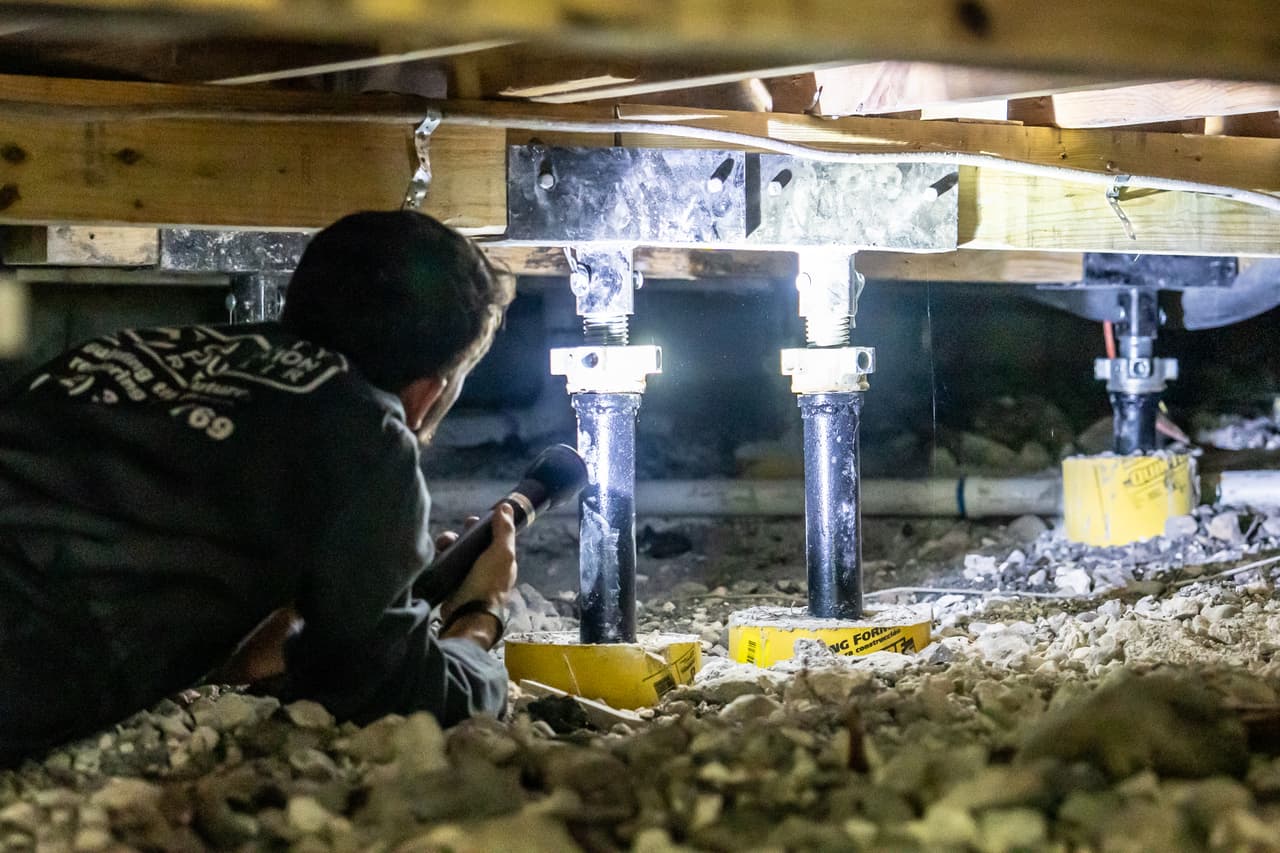
A pier and beam foundation holds the house up on piers and posts, with beams running between them. A crawl space sits between the ground and the floor.
The weight of the house travels down through the framing, into the posts and piers, and into the soil at those points. When one of those supports settles, the floor above it may start to sag, bounce, or feel uneven. You can read more in what a pier and beam foundation is.
How Can You Tell Whether Your House Is Slab or Pier and Beam?
You can often answer this by looking around the house, without any special access.
- Look for crawl space vents or an access door. Small vents or a hatch low on an exterior wall usually mean there is a space under the house, which points to pier and beam.
- Check how high the floor sits. A slab house often sits close to the ground. A pier and beam house often sits higher, sometimes with steps up to the front door.
- Notice how the floor feels. Wood framing over a crawl space can have some give and may sound hollow. A slab floor usually feels solid.
- Look where the floor surface is exposed. Bare concrete under the flooring suggests a slab.
These checks can give you a good idea, but they are not always conclusive. Some houses have more than one type. A pier and beam house may have a slab addition that was built later, and each part of the house may then need a different repair. An inspection can confirm what you have.
Pier and Beam vs Slab: How Does Each Type Show Movement?
The two types often show different signs when they move.
On a slab, movement tends to pass straight into the walls that sit on the concrete. Common signs include cracks above doors and windows and cracked floor tiles and grout.
On a pier and beam house, the wood framing can absorb some movement before the walls show it, so the floors often show the problem first. Floors that sag or feel bouncy are common signs in pier and beam homes.
How Is a Slab Foundation Repaired?
Quality Foundation Repair Austin stabilizes slab foundations with steel push piers that the company manufactures itself. The piers are driven down to soil layers firm enough to carry the weight of the house.
Those deeper layers are usually less affected by moisture than the clay near the surface.
You can read more about how push piers work and about slab foundation repair in general.
How Is a Pier and Beam Foundation Repaired?
For pier and beam houses, Quality Foundation Repair Austin uses Adjust-A-Piers. These piers can be adjusted again later if the ground shifts, so a future correction may not require replacing them. That can be useful in an area where soil moisture changes from one season to the next.
The pier and beam repair page covers the process in more detail.
How Does Austin Clay Affect Slab and Pier and Beam Houses?
Both foundation types sit on the same ground. Much of the Austin area has expansive clay soil, which swells when it gets wet and shrinks when it dries. Foundation movement usually comes from that change happening unevenly, with one area drying out or getting wetter faster than the area beside it. Dry summers tend to be when the shrinking is strongest.
Drainage is part of the same picture for either type. Water that pools against one side of the house can keep that soil wetter than the rest. Poor drainage around the foundation is one of the things an inspection looks at.
Pier and Beam vs Slab: Is One Easier to Repair?
There is no simple answer. The two types use different repair systems, and how much work a house needs usually depends on how far it has moved and why.
For either type, the goal is the maximum practical level for that house and its soil. A return to the original grade is not promised.
Warranty terms depend on the foundation type and the pressure each pier reaches during installation, and the full conditions are on the warranty page.
What If You Are Not Sure Which Foundation Your House Has?
If the checks above do not settle it, a foundation inspection can. Identifying the foundation type is part of what the visit covers.
For homeowners in the service area, an inspection is usually free. Real estate agents are billed for inspections. To book one, contact Quality Foundation Repair Austin.