Moisture and Mold Management
Moisture management keeps homes safe, durable, and comfortable. Here is how insulation, drainage, and crawl space conditions affect moisture and mold.

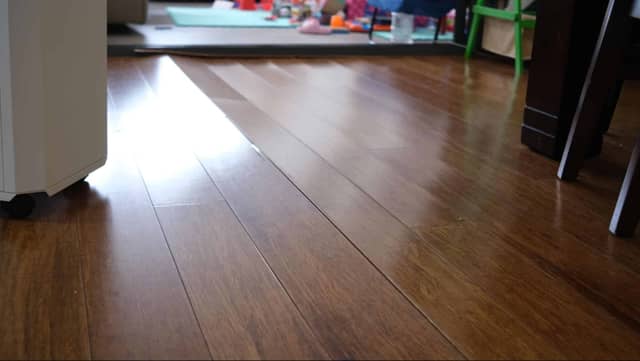
Moisture management is important because we want our homes to be safe, durable and comfortable, all while requiring reasonable amounts of energy for heating or cooling. The last thing we want to find is mold or decay. The key to preventing mold growth and decay is proper moisture management. It is also essential for preventing corrosion of nails and screws that hold the structure together and avoiding expansion/contraction damage such as cupping or buckling of wood flooring.
The traditional guideline for protecting wood and wood products from rot or decay is to keep the moisture content below 20 percent. Studies have shown, however, that mold growth can occur on wood at moisture content levels above 15 to 18 percent. Mold or corrosion will not necessarily occur if these levels are reached, but the significant factor is the amount of time the wood remains at an elevated moisture level.
Insulation affects moisture levels by slowing down the heat flow to keep the house warm when it’s cold outside and cool when it’s hot outside. Insulation provides some resistance to moisture encroachment, and this resistance can vary widely among different types of insulation. Insulation’s effect on limiting heat flow will make certain parts of the floor assembly warmer (or cooler) than other parts. Wood tends to dry when it is warm in relation to its surroundings and is predisposed to moisture accumulation when it is cooler than its surroundings.
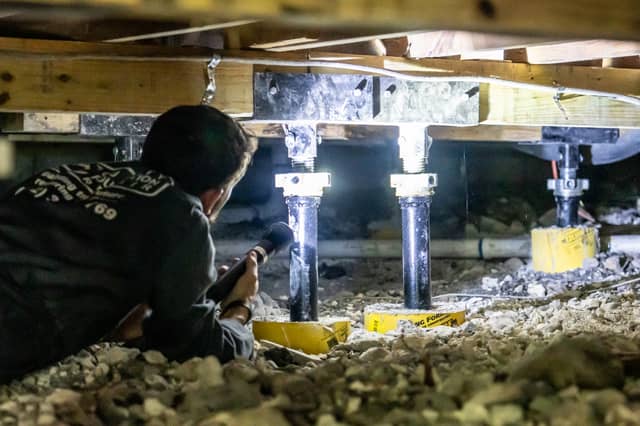
Managing rainwater and soil moisture, site grading and management of roof runoff can fundamentally determine how wet the soil becomes under a house. In general, the soil around the foundation should be graded so water drains away from the building. Wet soil under a raised house can supply a large amount of humidity to crawl spaces.
Humidity levels in open crawl spaces are essentially the same as outdoors. This means evaporation from the soil under an open crawl space is overpowered by a high rate of air exchange between the crawl space and the outdoors. If a house is to be built on a site with poor grading and drainage, an open, vermin proof crawl space would be a necessity. This can be achieved by using screened material on the crawl space entrance.
Water vapor often corresponds with movement from higher temperature to lower temperature. For example, when a building is air-conditioned and the outdoor climate is hot and humid, water vapor migrates through the building shell from outdoors to indoors. Water vapor will be retained by the subfloor from the outside, and this absorbed moisture will migrate through the subfloor. When the rate of wetting is higher than the rate of drying, moisture will accumulate in the subfloor, and problems like mold and rot can occur. The proper insulation under the subfloor should be selected to provide enough resistance to the existing moisture conditions.
Call Quality Foundation Repair for advice and a free estimate regarding moisture management.

Written by
Quality Foundation Repair Austin
Simon is the primary point of contact behind Quality Foundation Repair Austin's homeowner content. His articles cover foundation repair, house leveling, crawl space issues, and how Central Texas soil affects the ground homes are built on, the same diagnose-first approach the company brings to every on-site inspection.
More about Simon